
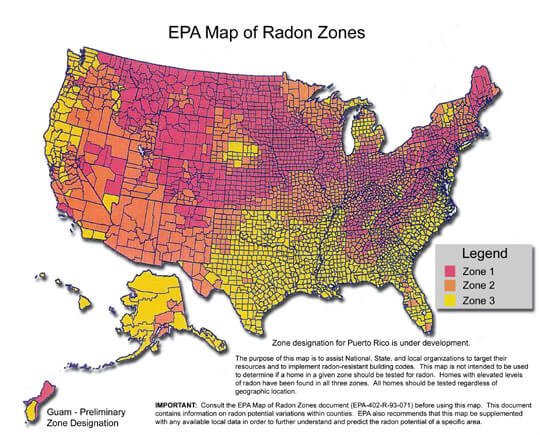
Radon is a radioactive gas. It comes from uranium and radium in soils, which can be found everywhere in the world. Uranium is present in rocks such as granite, shale, phosphate and pitchblende. Uranium breaks down to radium, which then decays into radon. This gas can easily move up through the soil into the atmosphere. Natural deposits of uranium and radium, not man-made sources, produce most of the radon present in the air.
- Radon is in the soil and air everywhere in varying amounts.
- People cannot see, taste, feel, or smell radon. There is no way to sense the presence of radon.
- Radon levels are commonly expressed in picocuries per liter of air (pCi/L), where a picocurie is a measure of radioactivity.
- The national average of indoor radon levels in homes is about 1.3 pCi/L. Radon levels outdoors, where radon is diluted, average about 0.4 pCi/L.
Radon in the soil can be drawn into a building and can accumulate to high levels. Every building or home has the potential for elevated levels of radon. All homes should be tested for radon, even those built with SANI-TRED radon protection features. EPA recommends taking action to reduce indoor radon levels when levels are 4 pCi/L or higher.
SANI-TRED Radon Gas Mitigation Test Results
Below are the measured radon test results of an average residential home basement in New Hampshire (installed by the homeowners)
- Radon Levels Before SANI-TRED Installation: 155.3 pCi/L
- Level of Radon considered acceptable: Below 4.00 pCi/L
- Radon Levels Immediately after SANI-TRED Installation: Main Living Area 0.2 pCi/L
- Radon Levels Immediately after SANI-TRED Installation: Secondary “Utility Area” 0.9 pCi/L
(“Utility Area” has native stone walls and remaining open earth pits for through pipe utilities.)
As demonstrated from test results, SANI-TRED customers receive unmatched Radon level reduction as well as completely waterproofing and damp proofing their basements at the same time!
How often in life do we receive such a double value bonus! Read on to learn about radon mitigation system repair.
University Of Wisconsin Milwaukee Lab Testing
We are happy to announce that in a University of Wisconsin Lab Testing SANI-TRED PermaFlex (with 3 coats on concrete) has passed an unprecedented vacuum testing 29″ Hg for 110 hours.
This is a perfect score and could not be any better for interior basement waterproofing! With a proven 99% effectiveness at eliminating radon and a perfect score of 29″ Hg for 110 hours no other product or system in the world is as effective as SANI-TRED FOR ELIMINATING PROBLEM RADON LEVELS.
Protect your family, and permanently increase the value of your home
Homes with SANI-TRED radon gas protection are also completely waterproof. (see: Basement Waterproofing) The SANI-TRED system eliminates all moisture, humidity, mold, musty odors and all other moisture associated basement problems. Offering homes with SANI-TRED radon protection attract more potential home buyers, which can translate into closing more sales and greater profits. Consumers are becoming more aware that radon gas is a health risk, and building a home with SANI-TRED radon protection features could give buyers one more reason to purchase a home from you. More educated and intelligent home builders install SANI-TRED radon protection in new home construction than ever before for these obvious reasons. They want to build a quality home free of wet basement or radon problems that may not exist now but may cause problems in the future. In high radon areas, all homes should be protected with SANI-TRED Radon Gas Removal to not only eliminate Radon but completely eliminate all possibility of future ground water or humidity problems.
Industry surveys continue to demonstrate a rapidly growing market for more energy-efficient, environmentally-friendly, comfortable, and healthy homes. SANI-TRED radon removal system is state-of the-art energy-efficient construction. The SANI-TRED radon system will decrease other soil gases entering the home such as methane, pesticide gases and volatile organic compounds helping to maintain high quality indoor air as well as energy savings and lower utility bills for the homeowner. The SANI-TRED radon removal system is permanent and self sufficient requiring no electrical or other power, there-fore it never wears out, turns off or needs upgrading or replacing.
The SANI-TRED radon system is a good investment for a home buyer
It is cheaper and easier to install SANI-TRED radon gas remediation during construction than to go back and remove other types of inferior quick-fix radon products, paints or sealers. On average, installing SANI-TRED radon gas removal features during construction costs about 50% less than if you already use some other in-effective paints, coating products or “sealers” in an attempt to achieve radon reduction and/or moisture control. In most cases these other types of materials create a “bond breaking” barrier that must be removed before installing the completely effective SANI-TRED radon removal system
SANI-TRED is always effective
A basic SANI-TRED do-it-yourself radon mitigation system effectively reduces radon levels by an average of far below 3.9 and, in most cases, to levels far below 1.0.
